Article -> Article Details
| Title | Why Networking Knowledge Matters for Cloud Professionals |
|---|---|
| Category | Education --> Employments |
| Meta Keywords | Cloud Computing Training in Bangalore |
| Owner | jothi |
| Description | |
| Cloud computing has transformed how businesses store data, run applications, and manage IT infrastructure. Companies increasingly rely on platforms such as AWS, Microsoft Azure, and Google Cloud to deliver secure, scalable, and reliable services. However, cloud technology depends heavily on networking to connect servers, applications, databases, and users. Understanding networking fundamentals helps cloud professionals configure infrastructure, troubleshoot connectivity problems, improve security, and maintain application performance. Developing these skills through practical learning and a structured Cloud Computing Certification Training Course can help aspiring professionals build a strong foundation for cloud-related careers.
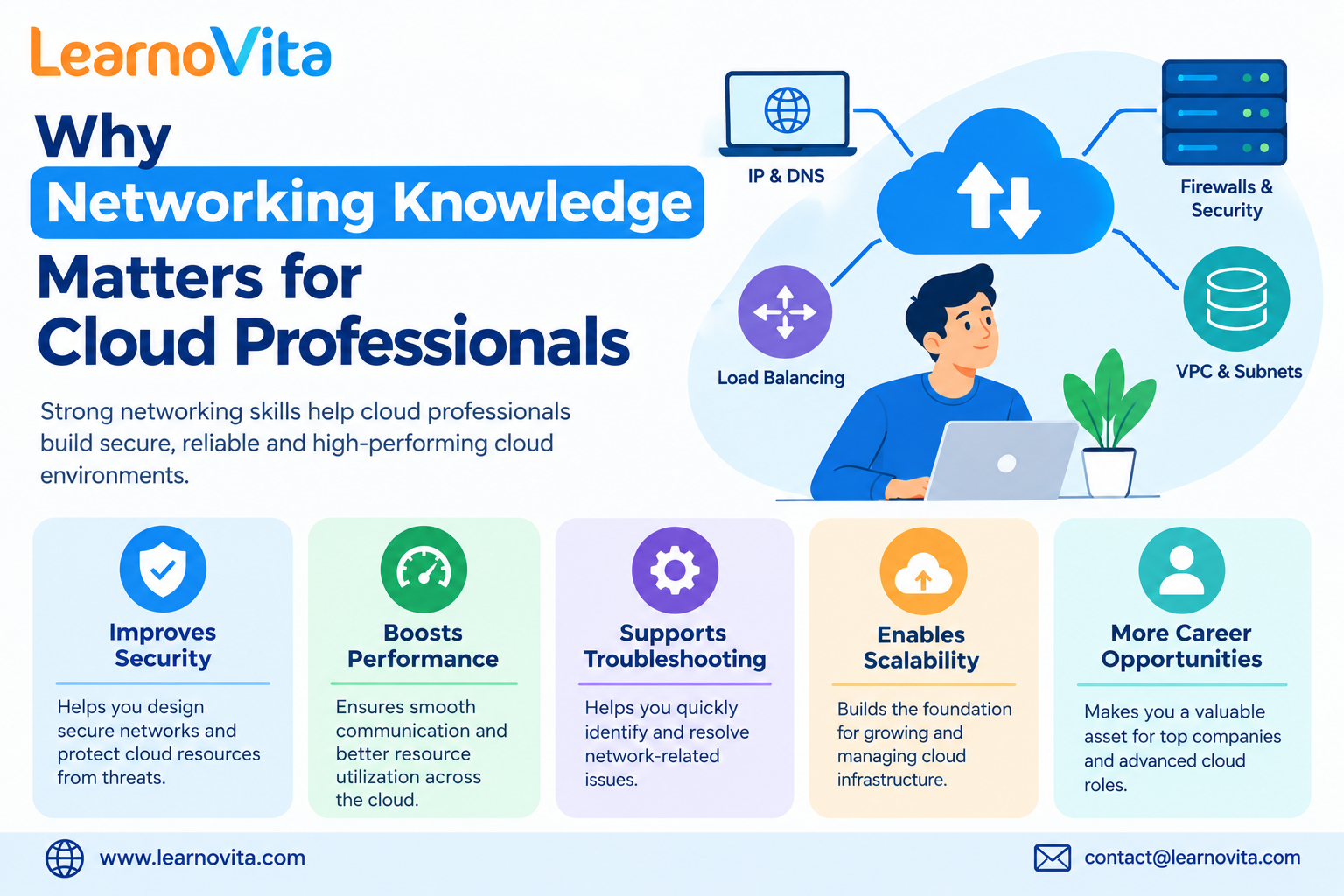
Understanding the Role of Networking in Cloud ComputingNetworking allows different cloud resources to communicate with one another and with users across the internet or private networks. Cloud professionals need to understand IP addresses, subnets, routing, DNS, ports, and network protocols to design effective cloud environments. These concepts help them connect virtual machines, configure private networks, and control how information moves between systems. Professionals who develop these fundamentals through Cloud Computing Training in Bangalore can better understand how networking supports cloud infrastructure and everyday business operations. Connecting Cloud Resources EfficientlyModern cloud environments contain virtual machines, storage services, databases, containers, and applications that must communicate securely and efficiently. Networking knowledge helps professionals configure virtual private clouds, subnets, route tables, gateways, and load balancers. Correct configurations allow applications to exchange information while keeping sensitive resources isolated from unnecessary access. Understanding these components also helps teams create cloud architectures that can grow alongside business requirements without compromising connectivity or performance. Strengthening Cloud Security Through NetworkingSecurity is an essential responsibility for cloud professionals, and networking knowledge plays a major role in protecting cloud environments. Firewalls, security groups, network access control lists, VPNs, and private connectivity options help control traffic between systems. Professionals must understand how ports, protocols, and network boundaries affect access to cloud resources. Learning these practices through Cloud Computing Training in Chennai can help learners understand how to reduce exposure, limit unauthorized access, and support secure communication between applications and users.
Troubleshooting Connectivity and Performance IssuesCloud applications can experience problems when network routes are misconfigured, DNS records fail, latency increases, or firewall rules block legitimate traffic. Networking fundamentals help cloud engineers investigate these issues systematically instead of relying on guesswork. Tools such as ping, traceroute, packet analysis, and cloud monitoring dashboards can help identify connection failures and performance bottlenecks. By understanding how traffic travels between services, professionals can resolve problems more efficiently and reduce service interruptions that affect business operations. Supporting Hybrid and Multi-Cloud EnvironmentsMany organizations combine on-premises infrastructure with cloud services or use more than one cloud provider. These environments require reliable connections between different networks, locations, and platforms. Cloud professionals need to understand VPN tunnels, dedicated network connections, routing policies, IP address planning, and network segmentation. Training through Cloud Computing Training in Hyderabad can help learners explore how these networking concepts support hybrid infrastructure, secure data exchange, and communication across distributed business systems. Improving Scalability and Application AvailabilityBusinesses expect cloud applications to remain available as user demand increases. Networking knowledge helps cloud professionals configure load balancers, distribute incoming requests, use content delivery networks, and design resilient network paths. These techniques can improve response times and reduce the impact of individual component failures. Understanding network capacity and traffic patterns also helps teams prepare for sudden increases in demand. When combined with automation and monitoring, these skills support cloud environments that are more reliable, adaptable, and efficient. Building Career-Ready Cloud Networking SkillsNetworking fundamentals are valuable for cloud engineers, cloud administrators, DevOps engineers, infrastructure specialists, and cloud security professionals. Employers often look for candidates who can connect theoretical concepts with practical tasks such as configuring subnets, securing access, troubleshooting DNS, and managing cloud connectivity. A structured Cloud Computing Certification Training Course can help learners build these skills through guided instruction, hands-on exercises, and real-world scenarios. Practising with cloud platforms and documenting project work can further strengthen technical confidence and prepare candidates for interviews and workplace responsibilities. Conclusion:Networking knowledge is a core skill for cloud professionals because it supports connectivity, security, troubleshooting, scalability, and reliable application delivery. Understanding how networks operate makes it easier to design cloud infrastructure, protect resources, and resolve technical issues. As organizations continue adopting cloud-based solutions, professionals who combine cloud platform expertise with strong networking fundamentals can be better prepared to handle infrastructure challenges and pursue long-term career growth. | |