Article -> Article Details
| Title | How Salesforce Experts Support Business Operations Through Real Projects |
|---|---|
| Category | Education --> Employments |
| Meta Keywords | Salesforce Training |
| Owner | jothi |
| Description | |
|
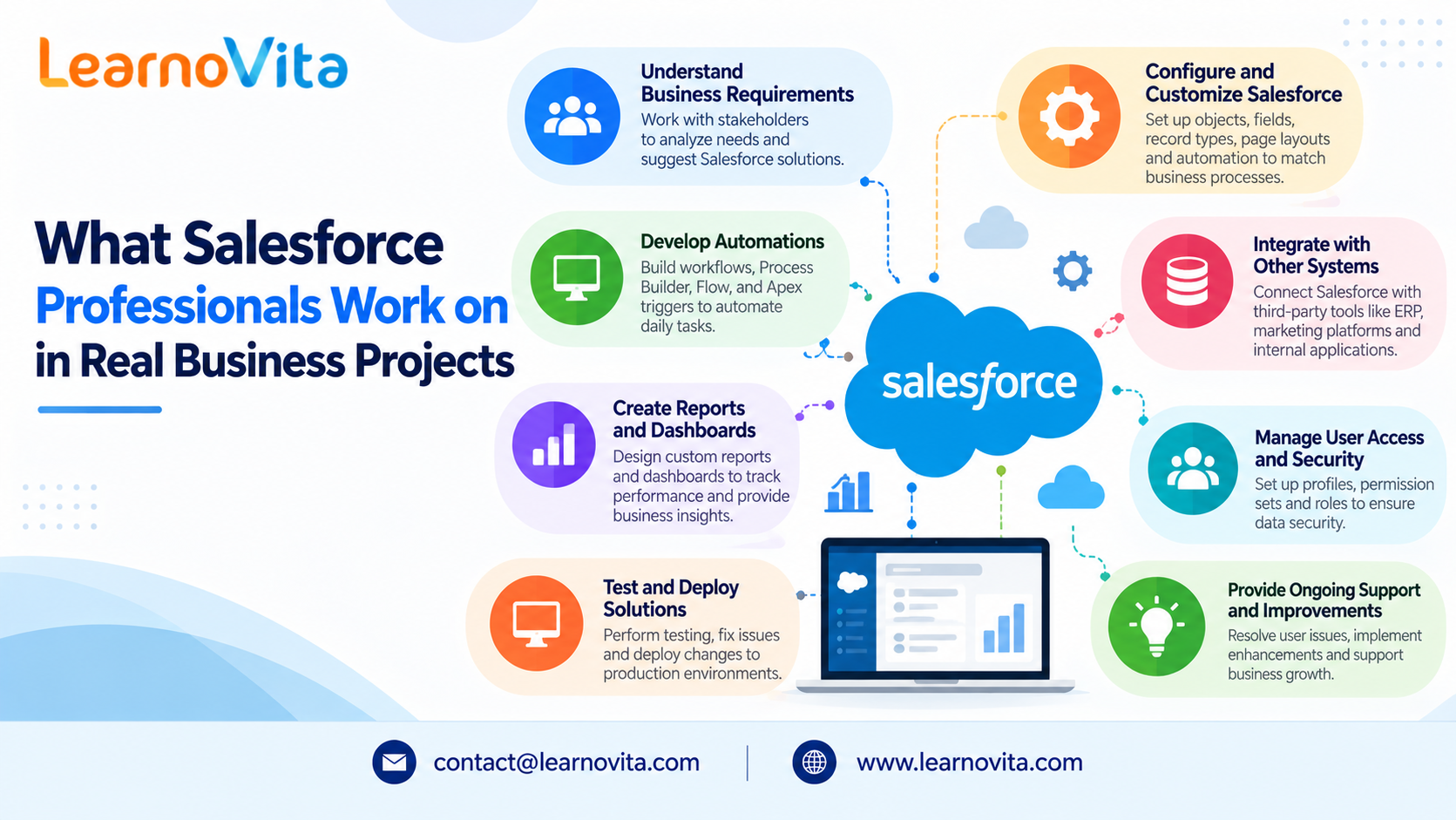
Salesforce plays an important role in helping organizations manage customer relationships, improve team productivity, and streamline business processes. Salesforce professionals work on practical projects that address challenges in sales, marketing, customer support, and reporting. Their responsibilities include configuring CRM applications, automating repetitive activities, maintaining customer records, and developing solutions that match business requirements. Understanding these real-world tasks helps aspiring professionals recognize how Salesforce knowledge can be applied in different industries. Identifying Business Needs and GoalsSalesforce projects usually begin with discussions about business objectives and existing operational challenges. Professionals work with stakeholders to understand their expectations, review current workflows, and identify areas that require improvement. They then recommend suitable Salesforce features and plan how to implement them. Developing these skills through a Salesforce Certification Training Course can help learners understand the relationship between CRM technology and business requirements. Managing Leads and Customer RecordsMaintaining accurate customer information is essential for effective sales and relationship management. Salesforce professionals organize leads, contacts, accounts, and opportunities so teams can access relevant information throughout the customer journey. They may configure duplicate checks, validation rules, and data import processes to maintain consistency. Reliable records help employees track customer interactions, prioritize prospects, and maintain better communication with potential and existing customers.
Streamlining Processes With AutomationSalesforce experts help organizations reduce manual work by automating routine business activities. They can use Salesforce Flow to assign leads, send notifications, update records, and initiate approval processes. For example, when a new lead enters the CRM, an automated process can assign it to the appropriate sales representative and schedule a follow-up task. Practical learning through Salesforce Training in Bangalore can introduce learners to automation techniques used to improve efficiency and consistency. Building Customized CRM SolutionsBusinesses often need applications that reflect their individual workflows and reporting requirements. Salesforce professionals configure fields, objects, page layouts, permissions, and record types to make the CRM suitable for specific teams. When standard configuration is not enough, developers may use Apex and Lightning Web Components to create additional functionality. These tailored solutions help employees complete tasks more efficiently while ensuring the system supports organizational goals. Strengthening Customer Support ServicesCustomer service teams use Salesforce to manage questions, complaints, and service requests. Professionals configure cases, queues, assignment rules, and escalation procedures so that requests reach the right support staff. They may also implement knowledge bases and self-service portals to help customers find information without contacting an agent. Learning through Salesforce Training in Chennai can help aspiring professionals explore how Salesforce Service Cloud supports organized and responsive customer service. Monitoring Performance Through ReportsOrganizations need clear performance information to understand whether their business activities are meeting targets. Salesforce professionals create reports and dashboards that present sales figures, conversion rates, customer service trends, and team performance. Managers can use these insights to identify delays, compare results, and make informed decisions. Well-designed reporting tools also help businesses recognize patterns in customer behavior and discover opportunities to improve their strategies. Testing and Integrating Business ApplicationsBefore a Salesforce solution is deployed, professionals test its features to confirm that workflows, permissions, automation, and data processing operate as expected. They investigate errors, resolve configuration issues, and verify that updates do not disrupt existing processes. Salesforce systems may also connect with websites, marketing platforms, payment applications, and enterprise software. Practical exposure through Salesforce Training in Hyderabad can help learners understand these implementation and integration responsibilities. Conclusion:Salesforce experts help organizations solve everyday business problems by managing customer information, automating workflows, customizing applications, improving support services, and analyzing performance. Their work requires technical understanding, analytical thinking, communication, and the ability to translate business needs into effective CRM solutions. Building practical Salesforce knowledge can help aspiring professionals prepare for roles in administration, development, consulting, and business systems support. | |